

NatHERS Certificate & Assessment Services
Save environment, cost, and get international recognition
What is a NatHERS Certificate?
<–Pending Content–>
NatHERS Certificate & Assessment Services
The Nationwide House Energy Rating Scheme (NatHERS) is a national system that assesses and rates the energy efficiency of new dwellings such as homes and apartments. Managed by the Australian Government (Department of Climate Change, Energy, the Environment and Water) on behalf of all states and territories, NatHERS plays a key role in regulatory processes, aiding the building industry in demonstrating compliance with the National Construction Code (NCC).
Starting in 2022, the NCC requires all new Australian homes and apartments to achieve a minimum energy efficiency rating of 7 stars under the Thermal Star Rating, a Whole of Home rating of 60 (out of 100) for home and a Whole of Home rating of 50 (out of 100) for homes apartments respectively. Read the NCC 2022 fact sheet on building for seven stars.
A NatHERS energy assessment helps homeowners, designers, architects, and builders make informed decisions about design and appliances. It supports the idea that new or renovated dwellings consume less energy and provide greater comfort. Currently, around 90 percent of new dwelling designs are assessed using NatHERS. It is also reported that the updated NCC minimum energy efficiency requirements are helping new homeowners save an average of $183 on their annual power bills.
Consulting with accredited NatHERS assessors is crucial for achieving compliance and optimising energy performance. Afogreen Build’s expert offers thorough evaluations and customised solutions to guide you smoothly through the NatHERS certification process.
What is a NatHERS Certificate?
NatHERS has two rating systems for new dwellings:
1. Thermal Star Rating
The Thermal Star Ratings provide information about a new dwelling’s thermal performance (heating and cooling needs) through NatHERS computer modelling tools. This is based on the design, materials, and construction, including the following:
- Layout of the new dwelling and its orientation.
- Roof, walls, windows, and floor, construction methods and materials.
- Shading from the sun’s path and how well it takes advantage of local breezes.
A star rating out of 10 is provided to show the thermal performance.
What the stars mean
- 0-2 Stars: New dwellings with these ratings have poor thermal performance and require significant heating and cooling to maintain a comfortable indoor temperature. This results in high energy costs and a substantial environmental impact.
- 3-6 Stars: These new dwellings are moderately efficient but depend heavily on artificial heating and cooling. While better than lower-rated new dwellings, there is still considerable potential for improving energy efficiency and comfort.
- 7 Stars: A 7-star rating is the minimum standard for new dwellings in many Australian states. These new dwellings offer decent thermal performance and use less energy for heating and cooling than lower-rated new dwellings, balancing cost and efficiency.
- 8-10 Stars: These new dwellings represent the highest level of energy efficiency. Due to excellent design, construction, and materials, they require minimal heating and cooling to stay comfortable. A 10-star new dwelling is rare and achieves near-complete thermal comfort through passive methods.
2. The Whole of Home Rating
The Whole of Home Ratings provide an easy-to-use rating to show how the new dwelling meets or beats the new NCC annual energy use budget, which requires consideration of the efficiency of the appliances used in new dwellings and the impact of solar and batteries.
Five key aspects are included in a Whole of Home assessment. These are:
- Heating, cooling, and hot water: specifying more energy-efficient appliances will reduce energy use and result in a higher Whole of Home performance rating.
- Spas and pools: having a pool or spa in a dwelling will reduce the Whole of Home performance rating.
- Onsite energy production and storage including onsite energy production and storage systems – will offset energy use, helping achieve the required Whole of Home performance rating.
- Cooking loads.
- Plug loads.
The Whole of Home Rating is based on the National Construction Code’s energy value metric. In addition to the current Thermal Star Rating assessment, out of ten, there will be a separate rating out of 100. The scale rating from Whole of Home Rating:
- 0 is the worst performance rating (there are no negative NatHERS ratings, so dwellings that would rate below zero are rated 0).
- 50 is the score of the benchmark dwelling, which consists of 100% of regulated loads plus the plug and cooking loads.
- 100 is the score of a net zero home (a dwelling with net zero societal cost).
The Whole of Home performance rating requirements under National Construction Code 2022 are shown below:
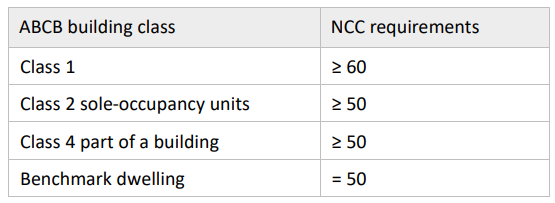
(Source: NatHERS website)
A NatHERS certificate provides numerous advantages for homeowners, designers, architects, and builders:
- Wider Range of Options
Unlike the NCC Deemed-to-Satisfy provisions, NatHERS allows for a broader selection of appliances, energy generation, and storage solutions. This flexibility supports new dwellings that exceed the minimum standards and can even generate more energy than they use.
- Trade-Offs Between Technologies
NatHERS enables a trade-off between various technologies and appliance efficiencies. For instance, using more efficient appliances might eliminate the need for solar PV installation while still meeting the NCC 2022 minimum requirements.
- Improved Energy Efficiency
It rates a new dwelling’s energy efficiency, helping to reduce reliance on heating and cooling, lower energy bills and greenhouse gas emissions, and improve overall energy performance. It also supports industry and homeowners in achieving zero energy (and carbon) ready homes.
- Compliance with Regulations
The NatHERS Thermal Star Rating and the Whole of Home Rating can both be used to meet compliance with the new NCC energy efficiency provisions.
- Increased Comfort
Higher ratings maintain consistent indoor temperatures, improving comfort by reducing reliance on mechanical heating or cooling.
- Higher Property Value and Enhanced Disclosure and Rental Standards
A NatHERS certificate boosts a property’s appeal to buyers, especially those prioritising energy efficiency and environmental impact. It also supports energy efficiency disclosure and rental standards, helping to improve the overall performance, comfort, and sustainability of new dwellings.
- Cost Savings
Improved energy efficiency leads to long-term savings on utility bills, making new dwelling more economical to live in.
- Tailored Recommendations
To further enhance sustainability, NatHERS suggests energy improvements, such as insulation or window placement. - Support for Green Loans
A minimum 7-star rating can qualify homeowners for green loans from certain insurance companies.
Why You Need a NatHERS Consultant
Role of a NatHERS Assessor:
NatHERS assessors play a crucial role in evaluating and certifying the energy efficiency of new dwellings. The accredited professionals possess the expertise to assess and optimise the thermal performance of residential designs, guiding compliance with energy efficiency standards.
Expertise
Trained to use accredited software, NatHERS assessors model the thermal performance of residential buildings. They understand how insulation, window placement, and building orientation affect energy efficiency.
Assessment Process
Assessors collect detailed information about the new dwelling’s design, materials, and location. They input this data into NatHERS-approved software to simulate its thermal performance and determine its star rating.
Recommendations
In addition to providing a star rating, assessors often offer suggestions for improving a new dwelling’s energy efficiency. These recommendations help homeowners, designers, architects, and builders make informed choices to enhance comfort and sustainability.
By collaborating with Afogreen Build as a NatHERS assessor, you can significantly enhance your building’s design to comply with energy ratings. We will analyse your plans and provide tailored recommendations. This proactive approach helps achieve the desired energy rating and creates a more comfortable and sustainable living environment.
Feel free to schedule an initial consultation today for expert guidance and to learn how we can help you optimise your home design for superior energy performance
Our NatHERS Assessment Process
At our NatHERS Assessment Services, we follow a thorough step-by-step process to offer accurate and reliable energy efficiency evaluations for buildings.
Step-by-Step Guide
- Initial Consultation: We begin with a consultation to understand your project requirements and goals. This includes discussing your design plans and any specific energy efficiency targets.
- Documentation Review: Our assessors review the plans, specifications, and any relevant documentation, which helps us gather the necessary information for the assessment. In addition, if the information or specific details to undertake a detailed assessment are not available or have not yet been made, default settings have been developed to be used in these situations.
- Energy Modelling: We use software tools to simulate the building’s thermal performance. This involves inputting data and other essential details into the assessment software.
- Rating Calculation: The simulation generates a star rating under the NatHERS framework. Our assessors analyse the results and identify opportunities for improvement if the initial rating does not meet the desired standards.
- Certification: Upon completing the assessment and making any necessary modifications, we issue the NatHERS Certificate with the logo, confirming the building’s energy efficiency rating.
At Afogreen Build, our assessors use NatHERS-accredited software tools to generate official star ratings and issue relevant certificates.
Benefits of a NatHERS Certificate
Minimum documentation required for Thermal Star Rating:
1. Drawing set
The drawing set provides the basis of design documentation used for the assessment and is essential for certification. The set should include the items listed below at a minimum:
- Site Plan
Minimum requirements include a north point indicating true north and location postcode.
Additional details may include the dwelling’s location in relation to the site, street address details, fences, contours, overshadowing structures such as adjacent buildings, and title boundary bearings.
- Loor Plan
Minimum requirements include room layout and room names or types, building and room dimensions, window and door locations, and numbering of individual dwellings (for class 2 buildings).
Additional details may include window and door sizes, floor coverings, the locations of ceiling penetrations such as exhaust fans and downlights, the location of ceiling fans, and shading structures such as eaves, pergolas, and privacy screens.
- Elevation
Minimum requirements include window and door location, size and opening type, roof pitch, material and style, and external wall materials.
Additional details may include external wall and roof colors, window operability and offset, shading structures such as eaves, pergolas, and privacy screens, ground level, floor level, and relative ceiling height.
- Section
Minimum requirements include ground level, floor level, and relative ceiling heights.
Additional details may include roof construction, materials and systems, insulation location, subfloor construction, and window head height and stair details.
2. Lighting location plan or electrical schedule
This documentation includes details such as the location of lighting, the type of downlight or pendant (light-emitting diode (LED), compact fluorescent light (CFL), fluorescent, etc.), the location, type, and size of ceiling or exhaust fans, and specific insulation clearance and/or sealing details for ceiling penetrations.
3. Construction details
Construction details include the construction components of the floor, subfloor, walls, ceiling, and roof, information on insulation installation, floor coverings, and finishes (including the colors of the roof and internal and external walls), and information and details on shading and overshadowing structures, including neighboring buildings.
4. Window and door information
Window and door information includes window and door types, including frame composition and opening style, window and door sizes (sometimes shown as an abbreviated code on the floor plan, e.g., 1820 may refer to a window that is 1800mm width x 1200mm height), glazing type and values, manufacturer name, and window codes if specified.
5. Notes and other details, including all communication with the client that has been used to inform the assessment.
Documentation required for Whole of Home Rating:
In addition to the documentation requirements for the NatHERS thermal modeling, the following documentation is required for Whole of Home Rating.
- Documentation for heating and cooling appliances shows any additional heating and cooling appliance type for each NatHERS designated conditioned zone.
- Hot water system specification.
- Documentation for pool and spa pumps shows the volume or surface area (to calculate the volume), pump type, and star rating.
- Onsite renewable energy documentation shows the array size, inclination, direction, and inverter capacity.
- Onsite energy storage (batteries) documentation shows the battery technology type and size.
- Documentation for the lighting power density.
- Documentation for the energy sources of cooking appliances.
Certified NatHERS Consultants
With extensive experience conducting thorough energy assessments and providing tailored design advice, we help your projects comply with the NatHERS rating system and meet NCC 2022 requirements. Our consultants work closely with you to identify opportunities for improvement. Contact us today to enhance your building’s energy efficiency with our expert guidance.
Frequently Asked Questions (FAQ)
How long does the assessment process take?
The timeline can vary depending on the complexity of the project. For further information, please get in touch with us (please link to the inquiry form).
How much does a NatHERS assessment cost?
The cost of a NatHERS assessment varies depending on the project’s complexity and the new dwelling’s size, location, and compliance requirements. Please get in touch with us for a detailed quote tailored to your specific needs.
What factors affect my NatHERS Thermal Star rating?
In adjusting the dwelling to meet a particular assessment goal, it is useful to consider some key principles of thermal performance. The following thermal performance principles should be considered to suit the client’s particular climate zone and dwelling requirements.
- Maximise solar gain in cool months and minimize solar gain in hot months.
Solar gain is heat transferred into a building from sunlight, and controlling it involves factors like building orientation, window placement, shading, external color, and insulation. Proper orientation maximises sunlight for heating in colder climates, while window placement, especially north-facing, can enhance solar gain but may lead to heat loss if not balanced. Shading devices are essential, with adjustable options providing control in different climates. Lighter exterior colors reflect heat, helping manage indoor temperatures, while insulation reduces heat loss or gain, enhancing comfort by minimising air leakage. - Maximise or minimise energy transfer
Energy transfer happens through conduction, where heat moves from warm to cool areas in walls, floors, roofs, glazing, and skylights. It can be controlled by improving insulation and design. Factors include dwelling shape, less external wall area reducing heat transfer, and grouping similar zones to minimise internal energy transfer. Insulating between different temperature zones, like bedrooms and garages, also helps reduce energy transfer. - Maximise ventilation and optimise infiltration
Ventilation is air movement through a dwelling, controlled by air paths like doors, windows, and fans. Factors include dwelling orientation for cooling, window and door placement for cross ventilation, and internal zoning for temperature control. Unsealed downlights can cause air leakage and reduce insulation, while window type affects airflow, with casement windows providing more ventilation than double-hung ones.
Can I improve my rating after the assessment?
Yes! If your new dwelling doesn’t achieve the desired rating, Afogreen Build will guide modifications to improve energy efficiency. Here are some options to improve a rating:
- Improve thermal rating: Enhancing thermal performance reduces the need for heating or cooling, boosting the Whole of Home rating.
- Use efficient appliances: Choose higher efficiency appliances and size them appropriately.
- Change appliance type: For better efficiency, consider switching from ducted air conditioning to room reverse cycle air conditioning.
- Switch fuel technologies: For example, switch from gas water heaters to solar electric ones.
- Install load-shifting technologies: Use systems like batteries or PV panels oriented to the west to reduce energy demand during peak hours or run heat pumps off-peak.
- Add onsite renewable energy: Install solar PV systems to generate renewable energy.
- Reduce home size: Encourage the client to reduce floor area, as Whole of Home calculations are based on floor space (m²).
Is the NatHERS assessment valid for all types of buildings?
NatHERS assessments primarily apply to residential buildings, including houses and apartments, for new construction and major renovation while the existing scheme is being released. However, commercial buildings may require different energy rating frameworks.
What are NatHERS accredited software tools?
There are currently four software tools in Australia that are accredited to assess compliance with the requirements of the National Construction Code:
- AccuRate Home Version v1.3.3.24 (using Chenath v3.24) includes Thermal ratings, Whole of Home ratings, Thermal and Whole of Home Certificates, and WERSLink Default Window Library.
- BERS Pro Version 5.2.4 (using Chenath v3.23) includes Thermal ratings, whole-of-home ratings, Thermal and whole-of-home certificates, and WERSLink Libraries.
- FirstRate5 Version v5.5.5a (using Chenath 3.22) includes Thermal ratings and Thermal Certificates but excludes WERSLink (the new Windows library).
- FirstRate5 Whole-of-Home (Version 1.0.1) includes Whole-of-Home ratings and Whole-of-Home Certificates but excludes PV Diverter hot water systems.
- Hero Version 4.1 (NCC 2022 profile using Chenath v3.23), which includes Thermal ratings, Whole of Home ratings, Thermal and Whole of Home Certificates, and WERSLink Libraries and excludes PV Diverter hot water systems
Hero, FirstRate5, BERS Pro, and AccuRate Home are all fully accredited, including certificates, and can be used for National Construction Code (NCC 2022) regulatory assessments.
Do I need to prepare anything before the assessment?
It’s helpful to have your architectural plans and specifications ready. Afogreen Build can provide you with any additional information needed for the assessment. Contact us now for further info (link to the inquiry form).
How can I ensure my home meets the 7-star requirement?
Here are the top tips for building for 7 Stars:
- Involve a NatHERS assessor early in the design process. Working closely with a NatHERS consultant from the beginning of your design process will help you identify and implement the strategies to meet a 7-star rating.
- Orientation is key
Design for the local climate, ensuring proper shade and solar access. Repositioning the house plan can significantly improve performance. - Improve glazing
Custom windows provide better flexibility for performance. Window sizing, placement, and shading should suit the climate. - Increase zoning
Adding more internal doors helps NatHERS provide more accurate heating and cooling estimates. Consider placing doors at corridor ends, the bottom of stairs, or closing off infrequently used rooms. - Insulate more
Improve ratings by increasing the R-value of wall, floor, and ceiling insulation or adding insulation to new areas like slab edges, garage walls, and internal walls. Be mindful of condensation risks. - Plan for fans
Installing ceiling fans in all rooms boosts your NatHERS rating and enhances homeowner comfort. - Check your colours
Adjusting roof and external wall colors can improve NatHERS ratings, especially by avoiding dark roofs in warmer climates. Some software even adjusts window frame colors for a noticeable difference. Discuss color choices with clients early. - Look at lighting
NatHERS rewards homes with fewer ceiling penetrations with higher ratings. Consider whether your design can delete downlights that aren’t IC4 rated, roof windows, and skylights, and replace these with other lighting options that allow for continuous ceiling insulation.
With Afogreen Build’s expertise, we will help you achieve the highest energy efficiency standards for your new dwelling.
How can I achieve a higher Whole of Home Rating?
To achieve a higher Whole of Home rating, consider selecting energy-efficient appliances, increasing solar PV on your home, and adding a battery to reduce energy imports during peak periods. These choices help lower energy consumption and improve your rating, with homes exceeding seven stars being rewarded for their efficiency.
When should the NatHERS Whole of Home assessment be re-simulated?
The Whole of Home assessment must be revised, and a new certificate must be issued whenever project specifications change.
Examples of revisions that require re-rating include:
- An updated NatHERS thermal assessment.
- Changes in appliance technology include replacing a room reverse-cycle air conditioner with a ducted reverse-cycle air conditioner, replacing a gas instantaneous hot water heater with a gas storage heater, switching from a gas cooking appliance to an electric one, replacing a lithium-ion battery with a lead-acid battery, and changing a variable pool pump to a single-speed pool pump.
- A decrease in appliance efficiency, such as replacing a 6-star gas heater with a 5-star model.
- Suppose an appliance or technology is replaced by a higher-efficiency version of the same type (e.g., a 6-star hot water system replacing a 5-star system). In that case, re-simulation isn’t necessary, though it may improve the rating.
Other revisions requiring re-simulation include:
- A decrease in Small-Scale Technology Certificates (STCs) for solar hot water and heat pumps, especially if the STC value falls below the substitution range noted in the certificate. Note that STCs reflect system efficiency or size, not just efficiency.
- A reduced PV system size or changes in its orientation or slope.
- An increase in pool or spa volume.
What if I have further questions after my assessment?
We encourage ongoing communication! After your assessment, feel free to reach out with any additional questions or for clarification on the results.
Does each dwelling in a multi-unit development need its own NatHERS certificate?
Yes, every dwelling must have its own individual NatHERS certificate, as outlined in the NatHERS Technical Note. This applies to all Class 2 houses in a single building or development, even if the design is repeated across multiple projects. Each dwelling must be assessed and rated based on its specific characteristics, ensuring an accurate energy efficiency evaluation for each unit.
When multiple Class 2 multi-unit buildings are located close together as part of the same development, or when the strata plan identifies separate lots, a separate summary certificate must be completed for each building or lot.
Can NatHERS software rate only part of a dwelling?
No, NatHERS software tools cannot be used to rate only a part of a dwelling. When assessing an addition or extension to an existing dwelling, the rating must include both the existing and proposed areas of the home to ensure an accurate and comprehensive energy efficiency assessment.
How can I improve the heating load in a home to optimise the Whole of Home rating?
To reduce a high heating load and improve the Whole of Home rating, several design improvements can be made, including:
- Roof and External Wall Colors: Select dark colors for the roof and external walls to absorb more heat.
- Dwelling Sealing: Improve sealing with weather seals and draft stoppers, especially on exhaust fans (ensure compliance with NCC requirements).
- Insulation: Increase insulation in walls, ceilings, and roofs, and remove downlights that create gaps in ceiling insulation. Internal wall insulation between conditioned and unconditioned spaces, such as between the house and garage, can also help. Consider underfloor insulation and soft floor coverings like carpet or cork to reduce energy transfer further.
- Glazing: Maintain a moderate glazing-to-floor area ratio, use glazing units with low U-values (less than 4.0) and high solar heat gain coefficients (greater than 0.5), and limit south-facing glazing while increasing north-facing glazing for better solar gain.
- Shading Devices: Reduce the width of the shading device to allow more heat during winter or install operable shading devices to maximize solar gain in winter while providing shade in summer.
- Ventilation: Minimise roof and subfloor ventilation to reduce heat loss while complying with NCC requirements for ventilation.
- Thermal Mass: Decrease thermal mass if the climate doesn’t provide enough sun to heat materials effectively.
- Slab Insulation: Use slab edge or under-slab insulation, or consider a waffle pod slab, which provides both insulation and ground coupling.
- Repositioning and Orientation: Reposition the dwelling’s orientation or windows to maximize north-facing windows in living areas or re-design to optimize northern orientation and zoning.
These adjustments can help reduce heating demand, increase comfort, and improve energy efficiency, ultimately enhancing the Whole of Home rating.
How can I improve the cooling load to optimize the Whole of Home rating?
To reduce a high cooling load and improve the Whole of Home rating, consider the following design improvements:
- Roof and External Wall Colors: Choose light colors for the roof and external walls to reflect heat.
- Reflective Insulation: Use reflective insulation in walls and roofs to minimize heat transfer into the dwelling.
- Sarking: Add sarking under a tiled roof to reduce heat gain.
- Flooring: Hard floor coverings like polished concrete or ceramic tiles can keep spaces cooler, especially in areas not exposed to direct sunlight.
- Glazing: Maintain a glazing-to-floor area ratio of 20%-35% and use glazing units with moderate U-values (greater than 4.0) and low solar heat gain coefficients (less than 0.5). Limit glazing on east and west-facing walls or add shading devices.
- Shading Devices: Increase the width of shading devices on the north, west, and east sides, or install operable shading devices for seasonal flexibility.
- Cross-Ventilation: Relocate doors and openings to maximize airflow through the dwelling, aiding natural cooling.
- Ceiling Fans: Install ceiling fans to help circulate air inside (ensure compliance with NCC).
- Roof Ventilation: Increase roof ventilation using whirly birds and eave vents, ensuring compliance with fire safety regulations.
- Thermal Mass: Increase thermal mass by adding feature walls or using a slab-on-ground design, which stabilizes indoor temperatures.
- Slab Insulation: Consider slab edge insulation, under-slab insulation, or a waffle pod slab for both insulation and ground coupling, which will improve temperature stability year-round.
These strategies help lower the cooling load, boost energy efficiency, and improve the home rating.
Ready to enhance your building’s energy efficiency and obtain your NatHERS Certificate?
Contact us today to schedule your NatHERS assessment!
For more information or to get started, please call or fill out our inquiry form. Let’s work together towards a more sustainable future!
